

- All
- About McmIllan
- Fit & Compatibility
- Lead Time & Order Status
- Materials & Construction
- More Information
- Pricing & Ordering
- Warranty, Service & Shipping
What’s the difference between carbon fiber and fiberglass stock strength?
Carbon fiber offers a higher strength-to-weight ratio than fiberglass, making it the better choice for shooters prioritizing a lighter build without sacrificing rigidity. Fiberglass remains extremely durable and is often the better value option for shooters less focused on ounces.
McMillan offers stocks in both carbon fiber and fiberglass.
Is carbon fiber stronger than fiberglass?
Carbon fiber offers a higher strength-to-weight ratio than fiberglass, making it the better choice for shooters prioritizing a lighter build without sacrificing rigidity. Fiberglass remains extremely durable and is often the better value option for shooters less focused on ounces.
McMillan offers stocks in both carbon fiber and fiberglass.
Carbon fiber vs. fiberglass, which stock material is stronger?
Carbon fiber offers a higher strength-to-weight ratio than fiberglass, making it the better choice for shooters prioritizing a lighter build without sacrificing rigidity. Fiberglass remains extremely durable and is often the better value option for shooters less focused on ounces.
McMillan offers stocks in both carbon fiber and fiberglass.
How does carbon fiber strength compare to fiberglass?
Carbon fiber offers a higher strength-to-weight ratio than fiberglass, making it the better choice for shooters prioritizing a lighter build without sacrificing rigidity. Fiberglass remains extremely durable and is often the better value option for shooters less focused on ounces.
McMillan offers stocks in both carbon fiber and fiberglass.
Which stock is more durable, a carbon fiber or fiberglass stock?
Carbon fiber offers a higher strength-to-weight ratio than fiberglass, making it the better choice for shooters prioritizing a lighter build without sacrificing rigidity. Fiberglass remains extremely durable and is often the better value option for shooters less focused on ounces.
McMillan offers stocks in both carbon fiber and fiberglass.
What makes carbon fiber different from fiberglass in strength?
Carbon fiber offers a higher strength-to-weight ratio than fiberglass, making it the better choice for shooters prioritizing a lighter build without sacrificing rigidity. Fiberglass remains extremely durable and is often the better value option for shooters less focused on ounces.
McMillan offers stocks in both carbon fiber and fiberglass.
Is carbon fiber better than fiberglass for a rifle stock?
Carbon fiber offers a higher strength-to-weight ratio than fiberglass, making it the better choice for shooters prioritizing a lighter build without sacrificing rigidity. Fiberglass remains extremely durable and is often the better value option for shooters less focused on ounces.
McMillan offers stocks in both carbon fiber and fiberglass.
Do McMillan stocks crack in extreme cold or heat?
McMillan stocks are engineered and tested to hold up in extreme field conditions, from desert heat to alpine cold, without the expansion, contraction, or cracking issues common in wood or lower-grade composite stocks.
McMillan stocks are built and tested for extreme cold and heat, resisting the cracking and warping common in wood or lower-grade composites.
Do rifle stocks crack in cold weather?
McMillan stocks are engineered and tested to hold up in extreme field conditions, from desert heat to alpine cold, without the expansion, contraction, or cracking issues common in wood or lower-grade composite stocks.
Best rifle stocks for extreme temperatures
McMillan stocks are engineered and tested to hold up in extreme field conditions, from desert heat to alpine cold, without the expansion, contraction, or cracking issues common in wood or lower-grade composite stocks.
Do McMillan stocks crack in extreme cold or heat?
McMillan stocks are engineered and tested to hold up in extreme field conditions, from desert heat to alpine cold, without the expansion, contraction, or cracking issues common in wood or lower-grade composite stocks.
Do McMillan stocks crack in extreme cold or heat?
McMillan stocks are engineered and tested to hold up in extreme field conditions, from desert heat to alpine cold, without the expansion, contraction, or cracking issues common in wood or lower-grade composite stocks.
Do McMillan stocks crack in extreme cold or heat?
McMillan stocks are engineered and tested to hold up in extreme field conditions, from desert heat to alpine cold, without the expansion, contraction, or cracking issues common in wood or lower-grade composite stocks.
How does McMillan’s layup process compare to injection-molded stocks?
Hand layup allows precise control over fiber placement and fill density, resulting in a stronger, more consistent shell than mass-produced injection-molded stocks.
How does McMillan’s layup process compare to injection-molded stocks?
Hand layup allows precise control over fiber placement and fill density, resulting in a stronger, more consistent shell than mass-produced injection-molded stocks.
Are McMillan stock shells solid or does the fill material vary by model?
Fill material varies by model and intended use, from lightweight hunting fills to denser competition and sniper fills, each engineered for a specific balance of weight, rigidity, and vibration dampening.
McMillan has four fill options to meet your needs:
- Edge Tech – Our ultra-light option, built from carbon fiber cloth instead of fiberglass. It’s the lightest stock pattern we produce.
- Standard (Sporter) Fill – Solid fiberglass runs through the forearm and action area, with a dense two-part foam in the butt stock.
- Magnum Fill – Built for heavy recoil and magnum calibers, primarily on hunting stocks. Constructed the same as standard fill, but with heavier, thicker fiberglass in the recoil lug and action area to keep recoil manageable.
- Sniper Fill – Used mainly on magnum calibers in our tactical stocks. Built the same as magnum fill, except the butt stock uses lightweight fiberglass instead of foam, so hardware can be installed if needed. That fiberglass also helps balance rifles carrying larger barrel contours.
Are McMillan stock shells solid or does the fill material vary by model?
Fill material varies by model and intended use, from lightweight hunting fills to denser competition and sniper fills, each engineered for a specific balance of weight, rigidity, and vibration dampening.
McMillan has four fill options to meet your needs:
- Edge Tech – Our ultra-light option, built from carbon fiber cloth instead of fiberglass. It’s the lightest stock pattern we produce.
- Standard (Sporter) Fill – Solid fiberglass runs through the forearm and action area, with a dense two-part foam in the butt stock.
- Magnum Fill – Built for heavy recoil and magnum calibers, primarily on hunting stocks. Constructed the same as standard fill, but with heavier, thicker fiberglass in the recoil lug and action area to keep recoil manageable.
- Sniper Fill – Used mainly on magnum calibers in our tactical stocks. Built the same as magnum fill, except the butt stock uses lightweight fiberglass instead of foam, so hardware can be installed if needed. That fiberglass also helps balance rifles carrying larger barrel contours.
Are McMillan stock shells solid or does the fill material vary by model?
Fill material varies by model and intended use, from lightweight hunting fills to denser competition and sniper fills, each engineered for a specific balance of weight, rigidity, and vibration dampening.
McMillan has four fill options to meet your needs:
- Edge Tech – Our ultra-light option, built from carbon fiber cloth instead of fiberglass. It’s the lightest stock pattern we produce.
- Standard (Sporter) Fill – Solid fiberglass runs through the forearm and action area, with a dense two-part foam in the butt stock.
- Magnum Fill – Built for heavy recoil and magnum calibers, primarily on hunting stocks. Constructed the same as standard fill, but with heavier, thicker fiberglass in the recoil lug and action area to keep recoil manageable.
- Sniper Fill – Used mainly on magnum calibers in our tactical stocks. Built the same as magnum fill, except the butt stock uses lightweight fiberglass instead of foam, so hardware can be installed if needed. That fiberglass also helps balance rifles carrying larger barrel contours.
Will a McMillan stock fit a Remington 700 clone action?
Most clone actions built to true Remington 700 footprint specs will fit standard McMillan inlets, but tolerance varies by manufacturer. You can use our Stock Builder Tool to confirm which stocks fit your specific action.
Will a McMillan stock fit my action?
McMillan stocks can be custom inletted to match your specific action, or ordered with a universal inlet for broader compatibility. Use our Stock Builder Tool to confirm which stocks fit your action.
What are machined in pillars?
Machined-in pillars are aluminum sleeves set directly into the stock during the layup process, positioned exactly where the action screws pass through. This pillar system delivers the same benefits as a mini chassis, without the added weight, creating a solid, unyielding connection point between the action and the stock. With this system in place, bedding your action isn’t required.
To confirm compatibility for your specific setup email us at stocks@mcmillanusa.com.
Can a McMillan stock be adjusted for left-handed shooters?
Select models are available in left-hand configurations. Availability varies by stock model, check the specific product page or contact a rep to confirm left-hand options for your build.
Placement: Product page for relevant models, near the configuration options.
Why do prices vary between similar-looking McMillan models?
Pricing reflects the specific fill material, finish type, inletting complexity, and add-on options selected, not just the base model. Two stocks that look similar can carry very different builds underneath.
Can I get a quote before committing to a full custom order?
Yes, you can get pricing through our Build Your Own Tool or by contacting a rep at stocks@mcmillanusa.com before finalizing your configuration.
Do McMillan stock prices include inletting and finish, or are those extra?
Base pricing typically includes standard inletting; specific finishes, custom inletting requests, and add-ons like Decelerator pads or custom length of pull are priced separately. Full breakdown is available through the price list or Build Your Own Tool.
Can I expedite my order for an additional fee?
Every stock we build is handcrafted to order, so lead times reflect the work, not a bottleneck. That said, we can sometimes make room for a rush order depending on current shop capacity. Email your rep at stocks@mcmillanusa.com, tell them your timeline, and we’ll tell you straight whether it’s possible.
Is Ready to Ship inventory the same quality as a custom order?
Yes, same shop, same hands, same standard. Ready to Ship stocks go through identical construction, inspection, and quality control as every custom build. The only difference is timing. They’re already built and finished, waiting for the right rifle instead of being built to your exact spec on demand.
What voids the McMillan lifetime warranty?
Unauthorized modifications, such as removing material from the shell (beyond approved buttstock shortening) or improper bedding work by an unqualified gunsmith, can void warranty coverage. Full terms are outlined on our warranty page.
Does McMillan cover damage from a rifle accident or drop?
Warranty coverage is for material and construction defects, not damage from accidents, drops, or misuse. Reduced-cost repair options may still be available, email, stocks@mcmillanusa.com, our team to discuss your specific situation.
Can I get a McMillan stock serviced if I bought it used?
Yes, service and repair options are generally available regardless of original ownership, though original warranty coverage may not transfer. Contact our team at stocks@mcmillanusa.com with your stock’s details to confirm what’s available.
Are all McMillan stocks made in the same facility?
Yes. Every McMillan stock, from a hunting rifle build to a military contract, is laid up, finished, and inspected under one roof at our Phoenix, Arizona facility. No outsourced molding, no third-party finishing, no exceptions. When you order a McMillan, the same team and the same quality control process stands behind it, whether it’s your first custom build or your fifth.
Will I get updates while my McMillan stock is being built?
We don’t send automatic build-stage updates, but you can email stocks@mcmillanusa.com if your build time has extended beyond the estimated time for a status check. Please allow 1 to 3 business days for a reply.
Does lead time vary by stock model or fill type?
Yes. Painted finish stocks generally move faster than molded-in finish stocks. More complex fills, like Sniper or Magnum fill for magnum calibers, and more involved inletting.
Why do Ready to Ship stocks arrive faster than custom orders?
Ready to Ship stocks are already built and sitting in inventory, so there’s no wait for CNC time, fitting, or finishing. Custom orders are built from scratch around your exact specifications, which is what makes them fully personalized, but also what adds build time.
Can I still get parts or repairs for a discontinued McMillan stock?
If your stock was built by McMillan Stocks, our lifetime performance warranty against cracking, warping, or breaking still applies, even if that specific model isn’t currently offered. Contact stocks@mcmillanusa.com with your details and we’ll walk you through repair, replacement, or comparable alternative options.
What happened to McMillan’s older stock models?
Our model lineup evolves over time as we focus our craftsmanship on the stocks our customers rely on most. Some older or specialty models get retired, and if you’re trying to identify or replace one, send us photos, stocks@mcmillanusa.com, of your stock and we can help.
Can McMillan refinish or rebuild an older, out-of-production stock?
Yes, we offer repainting at a reduced price for our customers, and we can evaluate older stocks for refinishing on a case by case basis. Reach out through our Return Merchandise / Shipping Authorization process to start that conversation.
What’s new at McMillan this year?
We’re continually releasing new builds and finishes; and new releases through our Dev Project Program and Special Edition Pre-Order Program.
How much does Edge Tech fill save in weight compared to standard fill?
Edge Tech is our lightest possible build, made from carbon fiber cloth. Exact savings depend on your specific model and options, so ask your customer service rep, 623-582-9635, for a comparison on your build.
Does fill type affect the balance of my rifle, not just the weight?
Yes. Our Sniper fill, for example, uses lightweight fiberglass in the buttstock instead of foam specifically to help balance rifles carrying large barrel contours. Fill choice is about more than shaving ounces, it’s part of how your rifle handles.
What grip angle options does McMillan offer?
Grip angle and profile vary by model, since it’s built around your intended use, hunting, tactical, or competition. Speak with a customer service representative, 623-582-9635, about which model’s grip geometry fits your build and shooting position.
Will an adjustable cheekpiece improve my comfort behind the rifle?
Yes, an adjustable cheekpiece lets you dial in consistent cheek weld regardless of your optic height, which supports both comfort and repeatable accuracy. It’s available on many of our tactical and competition models.
Can McMillan reduce felt recoil through stock design?
Yes, stock design plays a real role in felt recoil, and our Decelerator recoil pad is chosen specifically for its recoil-reducing rubber density. Stock weight and fill choice also affect how recoil transfers to your shoulder.
What should a first-time McMillan buyer know before choosing a model?
Know your action, caliber, and intended use before you start, since every stock is built to order around those specifics. Decide if field weight or range stability matters more to you, and factor in your realistic lead time. The best place to start is our Build Your Own tool, where you can select your action, model, fill type, and finish and see your price update as you go. It’s a great way to explore your options and get a real feel for what a build will cost before you commit. If you’re not sure where to start, our team, 623-582-9635, can walk you through the full spec sheet.
Action compatibility – check here
We build stocks to fit a wide range of custom actions. To confirm compatibility with your specific action, check our Build Your Own tool, or contact stocks@mcmillanusa.com with your action’s make, model, and footprint, and our team will confirm fit before you order.
Does McMillan make a stock for a Remington 700 action?
Yes. The Remington 700 is one of the most common actions we build for, and we’ve been doing it for decades. Whether you’re running a factory 700 or a custom clone, we’ve got inlet options built to fit true, right down to the thousandth. Use our Build Your Own tool to choose your stock.
What stock fits a Tikka T3x?
We build stocks specifically inletted for Tikka actions. It’s a popular platform with our hunting and long range customers, and we’ve refined that fit over years of real world use. If you’re running a Tikka, we’ve got you covered. Use our Build Your Own tool to choose your stock.
Will a McMillan stock fit my Surgeon action?
We build custom inlets for Surgeon actions on a regular basis. Because Surgeon actions come in a few different footprints, give us your exact model and specs so we can match the inlet correctly. That’s the difference between a stock that fits and one that fights you. Use our Build Your Own tool to choose your stock.
Does McMillan make stocks for Defiance actions?
Yes. Defiance is a common request from our competition and precision hunting customers, and we build to their action specs. As with any custom action, exact measurements matter, so have your action details ready when you order. Use our Build Your Own tool to choose your stock.
My action isn’t listed, can McMillan still build me a stock?
Most likely, yes. We’ve built stocks for more action platforms than we could ever list on a webpage. Start with our Build Your Own tool to see your options, and if your action still isn’t showing up, send your specs to our team at stocks@mcmillanusa.com. We’ll work with you to find a fit.
What stock doesn’t require bedding?
A pillar-bedded stock, like McMillan’s, is built with the pillars machined in from the start. Unlike a standard drop-in stock that still needs bedding for a precise fit, a machined pillar system locks the action in place as part of the manufacturing process, like a mini chassis. Although, some shooters still choose to bed their actions for even greater precision.
What’s the difference in comfort between a fixed and adjustable buttstock?
An adjustable buttstock lets you fine-tune length of pull and cheek height to your exact position, which matters most for shooters switching between gear setups or optics. A fixed buttstock is simpler and lighter, and works well once your LOP is dialed in and staying consistent.
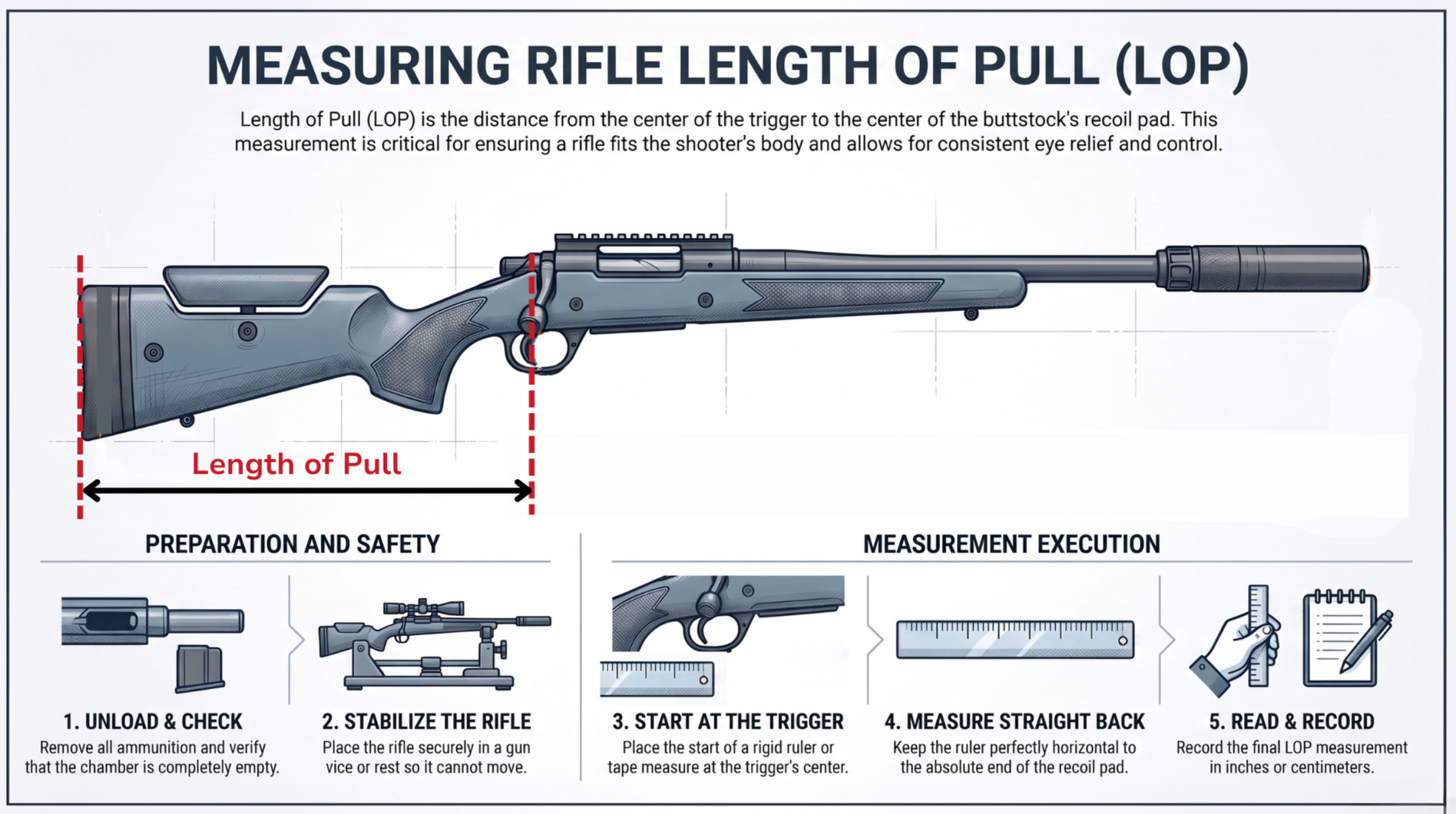
Use this diagram to measure LOP:
How do I know if a stock will be comfortable for long prone sessions?
Comfort over long sessions comes down to length of pull, cheekpiece fit, and recoil pad choice matched to your body and your caliber. Getting your LOP measured correctly and choosing the right pad, like our Decelerator, up front makes the biggest difference.
Use this diagram to measure LOP:
Is there a McMillan stock built specifically for backcountry hunting?
Yes, our hunting and sporting line is built with backcountry use in mind, carbon fiber stocks generally weigh 26 to 30 ounces to keep pack weight down without sacrificing durability.
Why is my McMillan order take longer than the quoted estimate?
Every stock is built entirely to your order, and quoted timelines are based on the specifics of your order. If your build has taken longer than the estimated time, please email stocks@mcmillanusa.com for a specific update on your order.
What are McMillan stocks made of, and what’s inside them?
McMillan stocks are not hollow, and they don’t run on a foam core. That’s a common misconception, and it’s worth clearing up. What’s inside depends on the fill, and the fill is chosen based on caliber, recoil, and intended use.
Edge Tech
Our ultra-light option. Built from carbon fiber cloth, not fiberglass, Edge Tech is the lightest stock pattern we produce.
Standard (Sporter) Fill
The fill used in the majority of our stocks. Solid fiberglass runs through the forearm and action area, with a dense two-part foam in the butt stock. Standard fill is built for calibers up to and including .300 Win Mag.
Magnum Fill
Built for heavy recoil and magnum calibers, primarily on hunting stocks. Constructed the same as standard fill, but with heavier, thicker fiberglass in the recoil lug and action area to handle recoil and keep it manageable on the shooter. Used for anything above .300 Win Mag.
Sniper Fill
Used mainly on magnum calibers in our tactical stocks. Built the same as magnum fill, except the butt stock uses lightweight fiberglass instead of foam, so hardware can be installed if needed. That fiberglass also helps balance rifles carrying larger barrel contours.
And on hunting stocks specifically, some foam is used in targeted areas. That’s by design, to cut weight without cutting performance, not a shortcut.
What manufacturing process does McMillan use?
We use the method commonly referred to as hand-laminating. Layers of carbon fiber or fiberglass cloth are laid in a mold by hand, then cured under heat and pressure. This adds strength, reduces weight, and eliminates voids when compared to other methods of spraying or molding.
Are McMillan stocks made in the USA?
Yes. From start to finish, McMillan stocks are made entirely in Phoenix, Arizona, USA.
Can I choose between carbon fiber and fiberglass?
Do McMillan stocks use Kevlar?
No. Based on our testing, we determined that Kevlar does not improve the quality or strength of our stocks.
What colors are McMillan stocks available in, and what does molded-in finish mean?
We offer a wide range of both paint and molded-in finish options. Molded-in means the color and pattern are built directly into the exterior of the stock, not applied on top of it. That construction makes molded-in finishes more durable and more resistant to wear, since there’s no paint layer to chip or scratch.
Because the color is part of the shell itself, you may see mold lines, minor imperfections, sanding marks, or visible cloth, especially on lighter colors. That’s not a defect, it’s the nature of the process. Molded-in finishes show off carbon fiber shells particularly well and look sharp in marble patterns.
If you want a solid color or a less reflective finish, paint is the better option. We don’t offer solid molded colors, the imperfections that come with a solid molded finish don’t meet our standard.
For the most current color and finish offerings, visit our Colors and Finishes page.
What is a marble finish?
A marble finish blends two or three colors together to create a marble-like pattern. We can run nearly any color combination we stock, but not every combination looks equally strong once it’s applied. Browse our Colors and Finishes page to see real combinations and find one that fits what you’re after.
Will my McMillan paint finish chip, and what’s covered under warranty?
Molded-in colors don’t chip. Period, they’re built into the shell, not applied on top of it.
For painted stocks, we use only the most durable, catalyzed paint on the market, the best available. Under hard use and rough handling, you may see some dings and scratches over time, that’s expected wear, not a flaw in the work. We stand behind our painted finishes against adhesion failure. We don’t warranty normal wear and tear, no one honestly can. When your finish needs attention, we’ll repaint it at a reduced rate. We built it, we’ll stand behind it.
SEO Title: McMillan Stock Fit: Action-Specific vs. Universal Fit Explained
Will a McMillan stock fit my action?
Every McMillan stock is filled solid, then inletted on a CNC milling machine for a precise fit, not an approximate one. Most stocks are engineered for specific actions and are only offered for those actions, though we do offer universal fit options as well. Either way, the description is what tells you exactly what you’re getting: read the specifications listed below each stock for fit details, use our Build Your Own tool to confirm compatibility and configure your build, or contact one of our customer service reps directly.
Do I need to bed the receiver, and should the barrel be free floated?
No to both, in most cases, but talk to your gunsmith first.
McMillan stocks are built drop-in ready or custom fitted, so bedding isn’t required to get accurate results. That said, every rifle build is different, we recommend talking to your gunsmith or rifle builder and getting their recommendation based on your specific setup.
On free floating: after installing thousands of stocks, we’ve found that 98% of rifles shoot most accurately when the barrel is free floated. If you’re unsure whether your build falls into that 2%, that’s another conversation worth having with your gunsmith before you commit either way.
What’s the difference between a drop-in fit and a bedded fit?
A drop-in fit means the stock is inletted to accept your action without modification. A bedded fit means a gunsmith adds material around the action to lock out any movement and create a truly consistent point of contact.
Most drop-in stocks still need bedding to perform at a precision level. The inlet is close, but not exact, so the action can still shift slightly under recoil unless it’s bedded in.
McMillan stocks are different. We machine aluminum pillars directly into the stock at the action screw locations, essentially building a mini chassis inside the stock itself. Those pillars hold your action square and consistent, shot after shot, without bedding. Shooters looking for even greater precision bed their actions in addition to this mini chassis-like system.
Do McMillan stocks need to be bedded?
No. McMillan stocks are built with aluminum pillars machined directly into the stock at the action screw locations. That pillar system holds your action square and consistent without epoxy bedding, so you get precision fit straight out of the box.
Does McMillan have a mini chassis?
McMillan utilizes machined in pillars.
What are machined in pillars?
Machined-in pillars are aluminum sleeves set directly into the stock during the layup process, positioned exactly where the action screws pass through. This pillar system delivers the same benefits as a mini chassis, without the added weight, creating a solid, unyielding connection point between the action and the stock. With this system in place, bedding your action isn’t required.
To confirm compatibility for your specific setup email us at stocks@mcmillanusa.com.
Do McMillan stocks work with chassis-style bottom metal?
McMillan stocks are traditional stocks, not chassis systems, but many support aftermarket bottom metal and detachable magazine systems through custom inletting.
Machined-in pillars are aluminum sleeves set directly into the stock during the layup process, positioned exactly where the action screws pass through. This pillar system delivers the same benefits as a mini chassis, without the added weight, creating a solid, unyielding connection point between the action and the stock. With this system in place, bedding your action isn’t required.
To confirm compatibility for your specific setup email us at stocks@mcmillanusa.com.
What torque setting should I use for my action screws?
Many action manufacturers have their own recommended torque settings. Based on our experience, we recommend 45 inch lbs for most actions that do not have a specific recommendation from the manufacturer.
Can my stock be modified to fit a different barrel or bottom metal?
If the bottom metal or barrel you are converting over to is larger than what is currently machined in your stock, we may be able to modify it for a fee. Email us at stocks@mcmillanusa.com for more details.
What is barrel contour, and what information do you need from me to build my stock?
Contour refers to the overall shape, taper, and thickness of the barrel. It’s what allows us to inlet your stock precisely for the barrel and action you’re running, and it’s how we make sure the barrel floats free with zero contact, every time.
That’s why we need specific information from you before we build.
If it’s the factory barrel that came on your rifle, we just need the caliber.
If it’s a custom barrel, we need three things: the barrel maker, the contour number, and the finished length of the chamber shank/cylinder, measured from the front of the receiver forward to the first contour change on the barrel.
Most barrel manufacturers publish detailed contour specs on their websites, that’s a good place to start if you’re not sure what you’re working with.
Do I need to send my rifle in for fitting, and how do I ship it?
For most stocks we build, we keep in-house barreled actions on hand for fitting. If we don’t have a match on hand, we’ll reach out and ask you to send in your barreled action so we can guarantee proper fit and function before it leaves our shop.
Feeding is critical on magazine-fed rifles, so for those builds, we strongly recommend sending your rifle in. We’ll fit the stock to your action directly, at no additional charge.
Instructions for shipping firearms to McMillan:
In compliance with ATF rules and regulations within the United States, firearms must be shipped back to the address they were sent from, or to an FFL holder.
All firearms must be shipped in a hard plastic gun case for protection. Include a letter inside the case with your name, address, daytime phone number, email address, and instructions. If you’ve already ordered a stock, include the order date.
Insure your rifle for full value.
FAQ Answer: Left-Handed Stock Availability
Most of our stock models are available for left-handed shooters, it’s not an afterthought, it’s built into the design.
Models like the Game Warden, Game Warden 2.0, A-3, A-2, Game Hunter and HTG/TEX are all inletted for left-hand actions, right alongside right-hand. Ready-to-ship left-hand inventory rotates based on what’s in the shop, but if you don’t see your model in stock, that doesn’t mean it’s off the table. It means it’s built to order.
Every stock we make is handcrafted around the shooter, not the other way around. Left-hand, right-hand, action type, barrel contour, we build it to fit you, not the other way around.
Check our Ready to Ship page for what’s in stock now or call the shop and we’ll walk you through custom-ordering the exact configuration you need.
How much does a McMillan stock weigh?
It depends on the stock and how you build it out. Our hunting and sporting stocks generally run 2 to 2.25 pounds, depending on the design and options selected. Tactical and high-power competition stocks are built heavier by design.
Final weight always varies based on the accessories you choose, adjustable components, recoil pads, and other options all add weight. There’s no single number that applies across the board, every stock is built to spec, and the weight reflects that.
Can my stock be made lighter or heavier?
Every stock we build is already as light as we’re willing to make it without compromising the strength and durability our reputation is built on. If you need something lighter than that, our Edge Tech ultralight hunting stock is the answer, it’s the lightest pattern we produce, full stop.
Going heavier is also possible. Weight can be added to meet specific balance or handling preferences, talk to one of our customer service reps, 623-582-9635, and they’ll help you figure out how to get there.
What is a Decelerator pad?
A Decelerator pad is a high-quality 1″ recoil pad made by Pachmayr. It has no open side vents and is made of a medium-density rubber specifically designed to reduce felt recoil. We chose this pad specifically because it’s one of the finest options on the market and can easily be modified to fit both standard and adjustable butt systems.
How do I choose the right recoil pad for comfort?
Our standard option is the Pachmayr Decelerator, a high quality 1-inch recoil pad with no open side vents, made of medium density rubber specifically designed to reduce felt recoil. We chose it because it’s one of the finest pads on the market, and it can be modified to fit both standard and adjustable butt systems. It’s available in Medium, Large, and X-Large sizes, in 1/2-inch or 1-inch thickness depending on the size. If you’re shooting heavier calibers or spending long days behind the rifle, this is where comfort starts.
What is length of pull, and how do I measure it?
Length of pull (LOP) is the distance from the middle of your trigger finger to the butt of your firearm’s stock. The beauty of a custom stock is that it can be made to your personal requirements. Most factory rifles come with a length of pull in the 13.5″-13.75″ range. You may want more or less, depending on your physique. Adjustable butt plates are available if you need that flexibility.
Use this diagram to measure LOP:
How to measure length of pull (LOP).
What inlet options are available for my stock?
Flat Top – A total stock blank. Gunsmiths and gunsmithing students often choose this when working on a project or keeping stocks on hand for future customer orders, so they can inlet any customer’s rifle model themselves.
Basic Inlet – The receiver outline and barrel channel are inlet, with float. No screw holes, trigger, safety, bolt handle, recoil lug, or bottom metal are inlet at all, only the action’s outline and diameter, and the barrel channel. Many gun shops choose this option to keep stocks on hand and finish the inletting themselves when a customer orders a build.
Full Inlet – A complete inlet for your rifle. Upon receiving the stock, your rifle should drop right in, bolt together, and be ready to shoot, no additional fitting needed. 80% of all our stock orders are built this way.
Can I alter the dimensions of my stock?
Every stock is engineered and constructed for maximum strength with minimum weight. Altering the external dimensions, with the exception of shortening the buttstock, will compromise the integrity of the stock and void the warranty.
Why do McMillan stocks cost what they do?
McMillan is dedicated to making the best stocks money can buy. The highest-grade materials, time, labor, and quality control required to do so are reflected in the price of the stock.
Want it now? Check our ready-to-ship inventory first. These are completed stocks, priced as-is, ready to go, no price list, no build-out, no waiting on a custom order. For a lot of shooters, this is the fastest and simplest way to get a McMillan in hand.
If you’re building custom, pricing works differently, and for good reason. There’s no fixed price on a custom McMillan stock, our pricing lets you build exactly what you need, whether you’re a gunsmith who wants a basic inletted blank or a customer who wants a fully finished stock ready to bolt your rifle into. You only pay for what you actually want.
To price out a custom build, download the current price list from our Build Your Own tab. It’s broken into two sections:
Hunting and Sporting stocks start with a base price for a fully inletted blank. From there, check the stock options and accessories list and add the cost of what you want, recoil pad and length of pull, sling or bipod attachment points (standard studs or flush cups), and any other options you choose. Add those to the base price for your total.
Tactical and Competition stocks start with a higher base price, these use a more solid fiberglass fill, which requires slower inletting speeds and more CNC machine time. From the options list, add whatever applies; adjustable cheekpiece, butt configuration (recoil pad or adjustable assembly), sling or bipod attachments, accessory rails, bipod studs, or machined-in metal pillars around the guard screw holes. Not every option is available on every stock, if you’re not sure, ask us.
The custom price list covers a lot of ground, and with that many options, it can get overwhelming fast. If you’d rather skip the math, call us directly at 623-582-9635 and we’ll walk you through it and get you a total.
How long is McMillan’s current wait time for a custom stock?
Current average delivery time on a custom order runs 2 to 4 months for painted finish stocks and 3 to 6 months for molded-in finish stocks. Delivery time varies depending on the volume of orders we’re working through at the time you order. If you already have an order in our system, email stocks@mcmillanusa.com for a status check. Please allow 1 to 3 business days for a reply, since it can take time to locate your stock among the thousands moving through our shop floor.
What are the stages of a McMillan custom order to shipment?
Start with our Build Your Own tool, where you select your action, model, fill type, finish, and options to configure your exact build and get your price. Once you submit your order with your full specifications, we begin building your stock shell around those exact choices from the first step. Because of this, changing options mid-build means scrapping the existing shell and starting over, so we recommend finalizing your spec in the Build Your Own tool before you order. If we need your rifle’s barreled action in-house for fitting, we’ll reach out to have you ship it to us so we can confirm proper fit and function. Full payment is due once your stock is finished and ready to ship, and we’ll charge the card on file.
How do I order and pay for a McMillan stock?
Need something fast? Check our ready-to-ship inventory first, these are completed stocks available to order and ship immediately, no custom build required. Payment is due at the time of order.
For custom orders, you can order directly through build your stock or over the phone by calling us at 623-582-9635. Full payment is due once your custom stock is finished and ready to ship, not at the time you place the order.
We accept credit cards and wire transfer for international customers. Your card information is securely stored in your customer account and charged upon completion of the stock. If we need updated payment information, our invoicing department will reach out to you directly with your order number.
McMillan has ready to ship stocks,
Need something now? Check our ready-to-ship inventory first. We keep a large stock of completed stocks on hand, ready to go out the door without the wait of a custom build.
How long does it take to get my stock?
If you’re ordering a fully custom stock, built to your exact specs, finish, recoil pad, adjustable cheekpiece, adjustable butt plate, barrel channel, that’s a different process. Every one of those choices is ordered, inletted, and finished individually, so timelines vary based on our current workload. Painted finishes generally move faster (2-4 months) than molded-in finishes (6-8 months). We’d rather take the time to get it right than rush a stock out the door with your name on it.
Already have an order in the system?
Email us at stocks@mcmillanusa.com and we’ll track it down. Give us 1-3 business days to respond, we’ve got thousands of stocks moving through the shop floor and finding yours takes a little legwork on our end.
Can I make changes to my order after it’s placed?
No, once an order has been placed, we cannot make any changes.
Our manufacturing process is dependent on the options you choose when placing your order. From the very first steps of producing a shell for your stock, we build your stock around the options you selected to ensure the best possible end product. If you change any options, we’d have to scrap the existing shell and start the process over from scratch. For additional questions email us at stocks@mcmillanusa.com.
What is McMillan’s warranty policy?
Please view our Stock Warranty page for details regarding our 100% Satisfaction Guarantee.
Does customization void my warranty?
Minor modifications won’t void your warranty. Major inletting or cutting into the stock will. If you’re not sure whether a change crosses that line, email us at stocks@mcmillanusa.com, before you start cutting. We’d rather answer the question up front than see you lose coverage over something we could’ve walked you through.
Why was my McMillan stock model discontinued?
Model lineups get streamlined from time to time so we can focus our craftsmanship and CNC time on the stocks our customers rely on most. If your model is no longer offered, that doesn’t mean you’re out of options, reach out to stocks@mcmillanusa.com with your stock details and our team can help with parts, repair, or a comparable current replacement.
Do I need authorization before shipping parts or firearms to McMillan?
Note: You must have a Return Material Authorization before shipping us any parts or firearms.
Under very specific circumstances, you may want to send your firearm or a part of your firearm (action, floor plate, etc.) in to our shop for custom fitting. In order for us to properly process these requests, please follow the instructions on our Return Merchandise / Shipping Authorization page.
How much does it cost to ship a McMillan rifle stock, and how is it shipped?
Shipping is free on every stock shipped within the continental United States. Once your build is complete, we ship via UPS Ground (other options are available at an additional fee). Delivery timelines depend on your destination and the shipping method selected at checkout; most orders arrive within a week once they leave our shop in Phoenix. International orders are handled on a case-by-case basis; contact our team, stocks@mcmillanusa.com, for a shipping quote outside the continental US.
How do I know if my stock is a genuine McMillan?
McMillan stocks aren’t stamped or labeled, so there’s no marking to check for. If you picked one up secondhand without paperwork, that’s a fair question to have, and an easy one for us to answer.
If you’d like help confirming yours, send us three photos: the right side, the left side, and a top-down shot of the inletting with the rifle removed. Email them to stocks@mcmillanusa.com and we’ll take a look.
How has McMillan improved its stocks over the last 50 years?
McMillan started in 1973 when Gale McMillan began building stocks for his own benchrest matches, using fiberglass and a hand layered process from day one. Since then, we’ve refined that process, layering glass cloth by hand and curing it under heat and pressure, which adds strength, reduces weight, and eliminates voids that spray methods leave behind. In 2004, we designed our first carbon fiber stock, the Hunter’s Edge, bringing a lighter, stiffer shell material option into the lineup without changing how we build, still hand-layered, still made the hard way. We’ve developed proprietary fill systems for different demands, from our Standard fill to Sniper and Magnum fills for heavy calibers, to our Edge Tech ultralight carbon fiber fill matrix. When the extreme long-range community needed a stock that could handle the torque and recoil of the biggest calibers at two miles and beyond, we built the ELR Beast. We keep evolving our proven models too. The Game Warden 2.0 took our best-selling long-range hunting stock and improved it based on real shooter feedback, adding a taller negative sloping comb for larger objective scopes and integrated thumb-shelves for more repeatable hand placement. We’ve continued to release new models, most recently the Mountain Tracker, along with new finishes through our Special Edition Pre-Order Program. Over 50 years of innovation that earn the results.
What separates a McMillan stock from other composite stock brands?
Every McMillan stock is hand layered. Carbon fiber or fiberglass cloth is laid by hand and cured under heat and pressure, not sprayed or injection molded. Our stocks are never hollow and do not utilize a foam-core, though some hunting stocks use foam in specific areas to save weight without sacrificing strength. Every stock is built entirely in Phoenix, Arizona, from start to finish. That’s backed by a lifetime performance warranty against cracking, warping, or breaking. Fifty years in, we’re still the stock other stock makers get measured against, not because we say so, but because that’s what decades of military, law enforcement, and hunting use has proven.
Is Grayboe made by McMillan?
No, Grayboe is not McMillan. It’s a separate company, a separate brand, and it’s not affiliated with McMillan Stocks.
Every McMillan stock is hand-laminated, layer by layer, cured under heat and pressure. That process takes more time and more skill, and it’s the same process that’s earned McMillan its reputation with military, law enforcement, hunters, and competitive shooters for over 50 years.
Is Mc3 made by McMillan?
No, Mc3 is not McMillan. It’s a separate company, a separate brand, and it’s not affiliated with McMillan Stocks.
Every McMillan stock is hand-laminated, layer by layer, cured under heat and pressure. That process takes more time and more skill, and it’s the same process that’s earned McMillan its reputation with military, law enforcement, hunters, and competitive shooters for over 50 years.
Have more questions?
We’re happy to help. Reach out through our contact page, email us at stocks@mcmillanusa.com, or call us directly at 623-582-9635.
